

Practical Steps You can Use on Your Jobsite Today.

1. NOTICE
(Notice. Ask. Share. Connect. Act.)
Spot the signs before it’s too late.
You don’t need to be a therapist or an expert, you just need to notice when something’s off with one of your own.
What to look for:
- Changes in mood or attitude
- Showing up late or missing days
- Losing focus or making mistakes
- Getting unusually quiet or argumentative
- Giving away tools or personal items
- Isolating from the crew
A simple example:
“He’s been late three days in a row and didn’t joke around like usual. Something’s up.”
Noticing is the first step.
It’s how conversations start and how lives get saved.
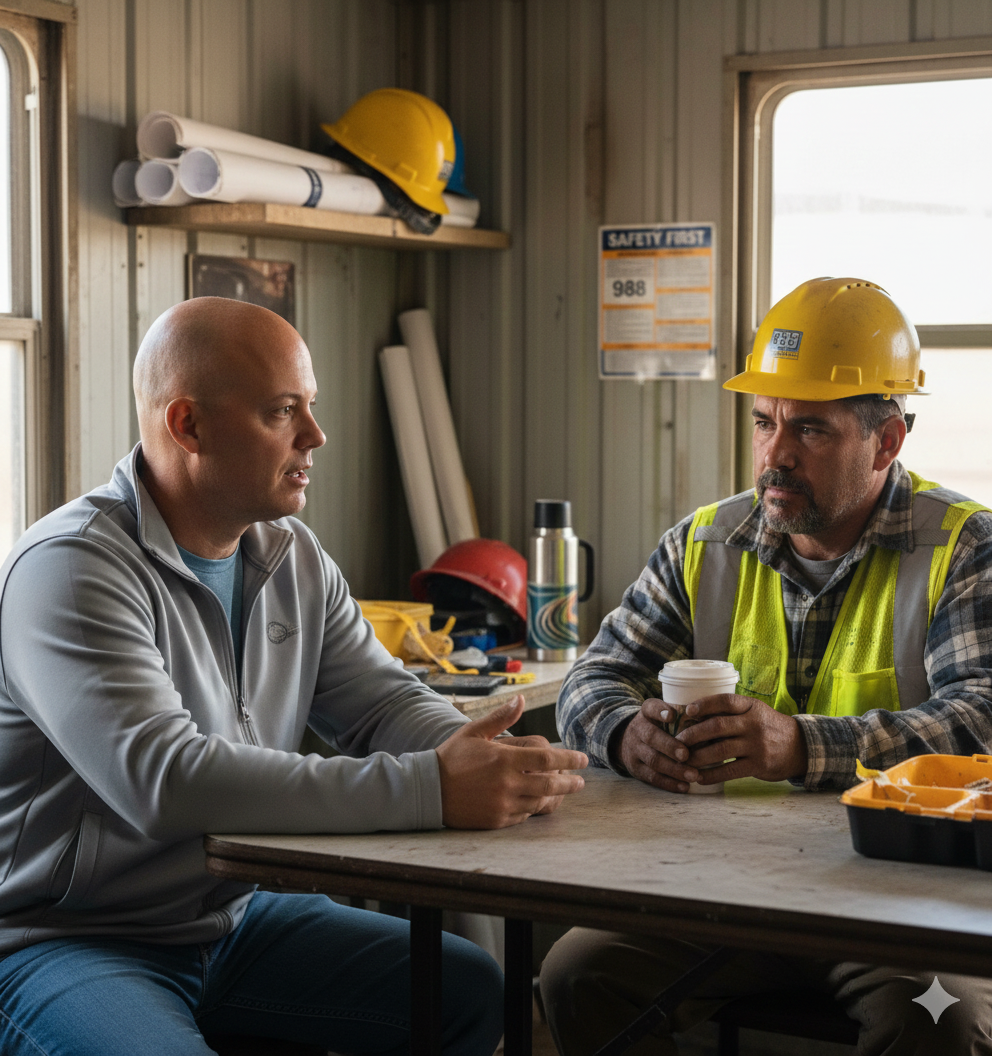
2. ASK
(Notice. Ask. Share. Connect. Act.)
A simple question can save a life because silence is the real danger.
You don’t need perfect words, you just need to ask.
Keep it real. Keep it human.
How to ask on a jobsite:
• “You good, brother?”
• “What’s the heaviest thing you are carrying”
• “Everything alright at home?”
• “You’ve been quiet, what’s going on?”
You’re not prying.
You’re checking in, the same way you’d check a service light.
A simple example:
Prevention begins with dialogue, not avoidance.
Tip: If they say 'I'm fine,' don't walk away. Wait five seconds and ask the 2nd question. Most of the real truth comes out in the silence.

3. SHARE
(Notice. Ask. Share. Connect. Act.)
Share something real, it gives them permission to do the same.
You don’t need to unload your whole story.
Just share enough to show you’re human too.
Ways to share without oversharing:
“I’ve had rough weeks too. This to will pass.”
“Hang in there, we’ll work through it together”
“I’ve been there. You’re not the only one.”
A simple example:
“Talking actually helped me more than I thought it would.”
Sharing isn’t weakness. It’s leadership.
When you share, you care and make it safe for them to share too.

4. CONNECT
(Notice. Ask. Share. Connect. Act.)
Don’t leave them hanging, connect him to someone who can help.
You’re not fixing them. You’re not becoming his therapist.
You’re just helping them take the next step.
Ways to connect on a jobsite:
- Invite them to lunch or for coffee
- Sit in the truck for five minutes
- Bring in a foreman, safety lead, or someone they trust
- Encourage them to reach out to a friend or family member
A simple example:
“You don’t have to figure this out all alone. Let’s call 988 together - or I’ll drive you myself.”
Connection is the bridge between talking and getting help.

5. ACT
(Notice. Ask. Share. Connect. Act.)
If something feels off, do something.
Action doesn’t have to be dramatic.
It just has to be something.
Ways to act:
- Stay with them a few minutes
- Keep in touch throughout the day
- Let a supervisor or trusted coworker know you’re concerned
- Encourage them to take a break, call someone, or step away from the noise
A simple example:
“I’m checking on you later today. Don’t disappear on me.”
Acting shows you mean it.
It’s how conversations turn into second chances.